A coastal handrail is more than a grade number
Use a hypothetical outdoor handrail as a desk check. The architect selected 316 because of the stated exposure. The rail has four mitred corners, welded posts and three visible faces. Cleaning chemicals, nearby salt and trapped water at the base plates all appear in the design notes.
Procurement receives only a line for “316 square tube, brushed.” That line has lost the product standard, exact grade designation, wall, finish reference and visual acceptance. It also says nothing about which party cuts the mitres or treats the welded areas.
Put the information back in stages. Engineering confirms the precise grade under the governing standard and checks the exposure assumptions. The drawing supplies outside size, wall, interfaces and drain details. The finish schedule identifies the visible faces and direction. The fabrication package controls welds and post-treatment.
Now ask what the tube supplier actually prices. Straight lengths with protective film? Cut and mitred pieces? Finished subassemblies? Those are three scopes. Do not compress them into one “per metre” comparison.
There is another quiet risk: a supplier may offer 316L and assume the change is welcome. Perhaps the project permits it; perhaps it does not. The buyer should record it as an alternative and let the named technical authority decide.
The lesson is modest. A grade can answer one important question and still leave ten practical ones open. Keep the exposure story, drawing and purchase line connected.
Confirm whether the grade is 316 or 316L
Once engineering selects a grade, preserve its full designation. 316 and 316L are related, not synonyms. The RFQ and returned offer should carry the exact approved wording.
If the project permits either grade, say so and request separately identified alternatives. Avoid a slash such as “316/316L” unless the engineering documents define what that notation means and how it will be accepted.
Grade also needs a product home. ASTM publishes A554 for welded mechanical tubing—including square shapes—and A269/A269M for nominal-wall-thickness austenitic tubing in general service. The scopes are not interchangeable. Application and design basis choose, not the fact that both titles contain “tubing.”
Describe the exposure that drove the choice
A grade number cannot describe the exposure. Record weather, salt, cleaners, process residue, heat, condensation and dissimilar-metal contact as they apply. Also say whether staining would be a cosmetic issue, a functional issue, or both.
That short exposure note helps engineering check its selection and lets a bidder challenge a bad assumption. It also discourages the idea that 316 is a universal upgrade. Surface, fabrication, joints, cleaning and maintenance remain part of the material system.
Fitness for service does not come from a web page. Significant corrosion consequences require the project's responsible engineer and governing documents.
Define square-tube dimensions without shortcuts
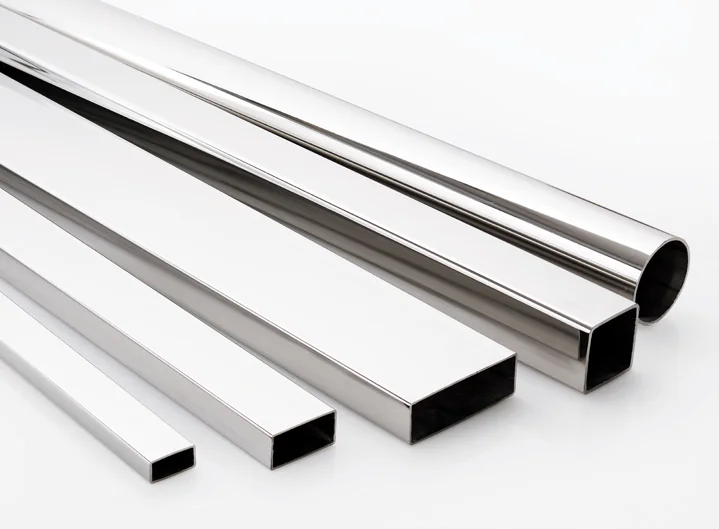
List both outside dimensions, units and nominal wall. State the tolerance reference and any additional functional limits. Corner geometry matters around inserts, close pockets, mitres and visible reveals, so dimension critical interfaces on the drawing.
Do not calculate internal clearance as outside size minus twice the nominal wall and assume the full square remains usable. The inside corners are radiused, and tolerances consume space. For an insert or telescoping part, control the actual mating geometry.
Length also belongs in the description. Fixed cut parts, mill lengths and random lengths are different offers. For cut pieces, define end squareness, burr condition, marking and the cut-list revision.
Finish is a functional field, not decoration at the end
Square tube can expose several faces at once. Specify the finish reference and identify which faces are visible. On directional finishes, mark the direction. If adjacent pieces meet at a corner, state whether appearance must remain consistent across the joint.
The delivered surface will not remain untouched. Welding, grinding, bending, cutting and handling each leave a signature, so tell the bidder what happens next and where protection must survive.
Adjectives such as satin, brushed and mirror travel poorly by themselves. Tie them to an agreed reference or sample. Record whether the sample controls texture, direction, gloss, colour or allowable marks, and retain the written requirement in case the sample goes missing.
Decide how much seam information the drawing needs
Many square mechanical-tube enquiries concern welded product. A seam or internal bead may meet a hole, insert, bend, cleaning path or exposed edge. Where that interaction matters, show the location and inspection basis.
No visible seam could ask for another route, a controlled orientation, an outside finish or treatment of the weld zone. Replace the slogan with the result the drawing and inspector can recognise.
For standard-led detail, use the ASTM A554 square tube guide. The square tube RFQ checklist organizes the same questions into a quote-ready request.
Put fabrication features on the same review
Few square tubes remain untouched straight lengths. Mitres, holes, slots, frames, caps and inserts all interact with dimensions, corners, seam and surface.
Attach the fabrication drawing by revision. Dimension corner-adjacent holes from clear datums and verify the available flat. Mark the faces seen after a mitre is assembled. Leave weld preparation to the approved design and procedure, not improvised sales copy.
For supplier fabrication, add a first-article or approval step only when risk justifies it. Reviewers must know what the sample proves; sample required alone says nothing.
Ask for evidence proportional to risk
Not every decorative frame needs a large document package. Not every critical assembly can be accepted from a packing list. Match evidence to the consequence of a wrong grade, dimension or finish.
Possible deliverables include order-specific material records, dimensional results, finish approval, fabrication inspection and traceability. Name the covered line and its link to the pieces. Brochures and specimen certificates remain background, never acceptance of a shipment.
At review, line up description, grade, standard, size, wall, finish and identifiers. The right grade attached to the wrong product form still fails the check.
Compare 304 and 316 without reducing the decision to price
Seeing a 304 price often prompts a request for 316. Return first to exposure and design. If both grades are technically permitted, quote separate rows while holding the other fields steady.
That makes the commercial difference readable. It also prevents a grade alternative from arriving with a different wall, finish, length or test package. The existing 304 stainless square tube page can help frame the alternate enquiry; it does not approve substitution.
Require the offered grade, not stainless. A proposed dual certification or different designation goes to the project authority with supporting records.
Write an RFQ that survives forwarding
Write for the reviewer who never saw the email. The line must carry square tube, outside sizes and units, wall, standard and edition, grade, length, tolerances, visible faces, finish, relevant seam controls, fabrication, tests, records, quantity, packing and destination.
Mark mandatory fields. Put alternatives and deviations in their own rows. Ask the supplier to confirm current availability and return assumptions in writing.
This is not excessive detail. It is the minimum needed to keep grade, shape and finish from becoming three separate conversations.
Technical references
Questions buyers ask
Is 316L automatically better than 316 for square tube?
No grade is automatically better for every job. Use the exact designation selected by the responsible engineer under the governing standard. If either designation is allowed, state that clearly and review separate offers.
Which standard applies to 316 stainless square tube?
It depends on product type and service. ASTM A554 is commonly relevant to welded mechanical tubing and includes square shapes; other applications may require another specification. Cite the project-approved standard and edition rather than choosing from shape alone.
Do I need to specify all visible faces?
Yes when appearance matters. Identify cosmetic faces, finish reference, direction, weld-area treatment, acceptable defects and any approved sample. Square sections often expose adjacent faces, making variation easy to see after assembly.
Can a web page confirm 316 square tube availability?
No. A page can explain how to specify the enquiry. Current size, wall, finish, grade, testing, quantity and delivery need confirmation in a written quotation tied to the exact line item.